Saw Watchmen yesterday. It was good. About as good as I expected. There were scenes that were incredibly campy, some that were profound. Among other things there was lots of blood; overly prettified fight choreography; a giant, naked blue man; too much CGI; and one sex scene that went on too long and in a kind of ridiculously showy manner. There seems to be somewhat universal agreement that the film adhered too closely to the comic book and failed to create its own identity. The critics loved Jackie Earle Haley's portrayal of Rorschach and hated Malin Ackerman's Silk Spectre. I thought they were both adequate. The major difference being that Rorschach's character—demented, violent, uncompromising—is just way more compelling to watch or read. It was the same in the comic book—its two best chapters are 5 and 6, which focus almost mostly on Rorschach.
My general feeling is that making Watchmen into a movie is about as silly as making Citizen Kane into a comic book. In adapting it, it lost a major component of what makes it such a great piece of work—its comic bookness. As much as it's a story about superheroes trying to save the world, it's also a story about debunking the myth of the comic book hero. And as much as it's a fine piece of pomo, non-linear storytelling, it's also really a twelve part course in how comic book stories are told—the ways to relate one comic book panel to another. And this last part, I believe, is really what made Watchmen "unfilmable" as its been called on so many occasions (probably most often by its cantankerous mastermind). It's unfilmable because one of the intrinsic values of the story is that it is a comic book.
There are certain things that comics allow for that helped develop some of the themes—symmetry and time—of Watchmen and this relationship between panels is one of them. The comic book's page-layout holds almost entirely to a grid divided evenly in 18 sections. Most pages had 9 panels, but whatever the configuration was, it held to that underlying grid. While it lent a certain rhythm and structure to the pages look and narrative pacing (the effects of which, I don't think I entirely understand), it also allowed for a vast use of symmetry in the page designs (see the page depicting Rorschach's capture). In as much as Watchmen was important to comics with respect to its mature subject matter (it being an instigator for the movement of comics' target audience from 8-to-12 year-olds to 18-to-30-somethings), it was equally important regarding how its panels tell the story.
The narrative flashes back and forth in time throughout the story. As Dr. Manhattan says later on in the book, "There is no future. There is no past... Time is simultaneous..." With the comic you can easily move forwards and backwards in the narrative just by turning some pages. By looking at an entire page at once you can see moments in the story happening simultaneously. Rorschach is a character of dichotomies. He sees everything in a prism of good/evil and right/wrong. His life is divided into two periods, when he was Walter Kovacs and when he became Rorschach. His mask is a mercurial Rorschach blotch, perpetually moving to make new symmetries. So the gimmick of using symmetry in the illustrations to underscore his character traits is an obvious enough device.
In the page depicting Rorschach's capture (and a number of other pages in book), the coloring of the panels is symmetrical. But the way in which that device functions in the comic is what makes it work so well. The physical motivation behind the color change in the panels is the flashing neon light in the background (The neon light features a symmetrical skull-and-crossbones in its design). The alternating color in conjunction with the rigidity of the grid-based layout acts as a sort of metronome, ticking off the moments until the issue's climax. And while it functions as a sort of timing device, in order to actually see the symmetry on the page the reader must look at all nine panels at once, such that what's happening in the first panel of the page is synchronous with the last panel. The symmetry is only apparent by making time stop in the story.
This is something that couldn't really be done in film. The comic book ties together these themes of symmetry and synchronicity in a very particular comic book-y way. Certainly the themes portrayed on film, but not in the same manner.
And this is one of the major strikes against the film. Outside of cutting scenes out of chronological order, there's little thematic play in its narrative technique. It cops the style of the comic without paying attention to the substance conveyed by that style. Snyder and co. didn't make much of an effort in that regard. They had an opportunity to create a very striking visual vocabulary (maybe using simultaneous imagery or montage, for instance) and they didn't. The only elements of the film they seemed to take liberties with were the credit sequence and the fight choreography and physics of battle, which were essentially a Matrix rehash with more blood.
A similar argument could be made for the murder mystery aspect of the story. Rorschach and Nite Owl's investigation into the Comedian's death and the reader's efforts to create order out of Moore and Gibbon's disjointed narrative are underscored by comics' innate qualities—the setting of illustrated panels together to create a larger picture. The comic doesn't just resemble a puzzle, it is a puzzle.
The movie, in the end, was the fireworks without the orchestra.
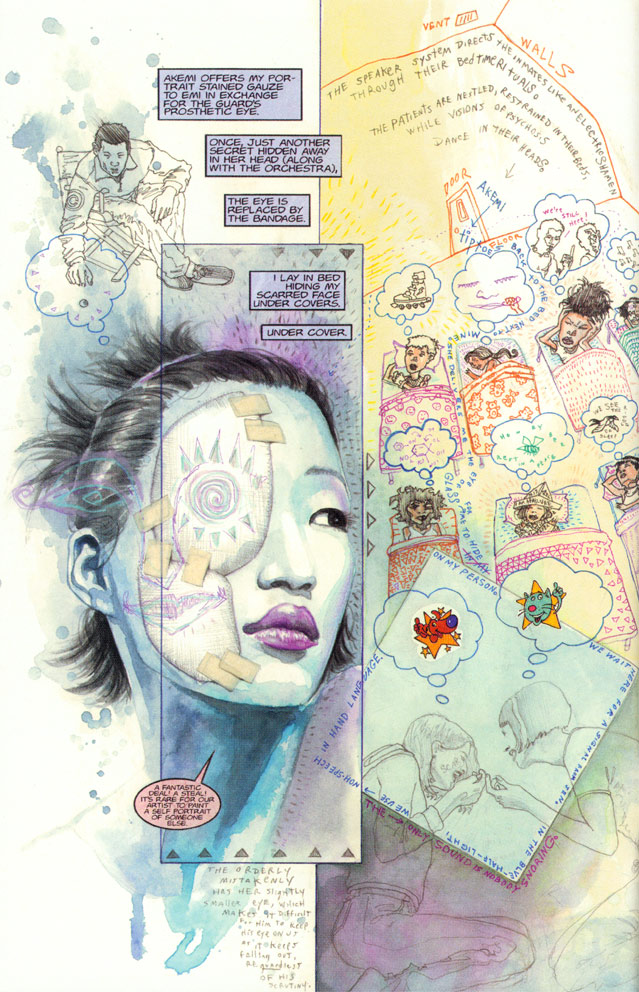
the art (click to enlarge) of Dave Gibbons, John Higgins, and Alan Moore:


more TK?

 rustoleum
 flora
flora
 recession
 pdx loves neck beards
 pdx loves bikes
 pdx loves walking
 pdx loves geometric shapes
 pdx loves posters
 more flora
 more more flora
 pdx loves decaying cherry blossoms
 bike farm loves you.







i think a number of you are missing the point of what this post is about. (or maybe i am?)
it seems to me that this post isn't in opposition to sex in advertising. it's against perpetuating what should, at this point, be outdated and unacceptable modes of thinking about women—the idea that women are sex objects and should be subservient, that their reason for being is to please men.
the post's author does not complain about ad campaigns like the one that Dove ran not too long ago featuring "real" women in their underwear or the Marithe & Francois Girbaud take on Da Vinci's last supper (http://img210.imageshack.us/img210/9694/thelastbrunch2ha.jpg), which are both sexy, eye-catching, and tasteful.
just as there would be an outcry if there was an ad-campaign depicting people in blackface, people should be upset when women are treated like sex toys.
it is offensive. and in this case it's also dehumanizing.
furthermore, regardless of the narrative that the viewer places on these images, they all have a clear subtext. You may not see the Dolce & Gabbana ad as as explicitly a gang rape scene, but it would be hard not to see it as an image depicting male dominance—a man appears to be holding a woman down while a group of other men look on without any of them showing a hint of misgiving. she's just an object for them to take advantage of.
the BMW ad is sexualizing a model with a very young features. while the model may in real life be of age, that does not seem to be what they are hoping to depict. and it doesn't excuse what seems to be an endorsement of pedophilia.
as for the LAMB ad, maybe there are societies where getting jizzed in the face is a noble deed to be trumpeted and applauded—the last ceremonial act before being crowned queen (or king) of all the land. but generally in the US, at least, it's considered somewhat degrading, and is often nothing more than the climax of male power fantasies.
for those of you that have the urge to defend these ads. stop and think if for a second. are you in favor of perpetuating male dominance? should children be portrayed as sex objects? were women put on this planet with the sole purpose of pleasing men?
i like beautiful, naked people. i like sexy ads. i don't like these ads.
Flashy, your post confirms that we each view an ad through our own eyes, bringing to it what we want to bring.
Now, I'm not trying to defend or attack the ads -- in a country where there's freedom of expression, even in advertising, you can't stop people from depicting whatever they think will sell their product -- unless you stop buying the product. But my point is sex sells, so they use it.
If you're objecting to the "objectification" of women, ANY ad does that. It then becomes a question of degree. I mean, you can't have "beautiful, naked people" and "sexy ads" without objectifying the subjects in the ad. A naked girl advertising soda is still naked, still an object of desire (supposedly), and is still being used to hawk a product, whether she's standing in the street, sitting on a bench, or lying on a bed with a guy.
The same is true about a beautiful girl, in tight jeans and a t-shirt, hawking the same soda. You're attracted to the girl, and then you notice the soda.
Same with the ads for men's cologne on tv -- you see guys with 6-pack abs playing soccer, and then you're told about the product. ALL advertising with models is objectifying the subjects for the sake of the product (unless the ad is simply a picture of the product). And ads that depict pseudo-rape, or purported "pedophilia" are simply pushing the envelope as far as they can before they alienate the consumers to the point where they won't buy the product.
As I mentioned before, the ads are not going to create the desire in people to rape, or stalk children, or act like sluts. They may attact people with those predipositions to the product, which is the point of advertising, but they don't cause the problem, and they don't perpetuate it. They feed on a pre-existing attitude for the sake of sales.
David—I agree with you that all understanding is subjective. However, I wasn't intending for my argument to be about personal perception or semantics, but rather about social perception, social norms, values, and morals.
I do not believe that men will go running about gang-raping women upon viewing the Dolce & Gabbana ad. However, I do believe that images like that both reflect and help perpetuate patriarchal tendencies. When images like that are presented as a selling point instead of in a critical light, it only reinforces those kinds of gender roles whether you're interested in participating in a dominant–submissive relationship, or whether you're just interested in socially interacting with the opposite sex. We see the effects of male dominated society everywhere, from the gender split in classroom participation, to who runs the country (politically and economically), to the picture people imagine when they think of the words scientist and homemaker.
If I had a daughter I wouldn't want her bombarded by images of submissive, subservient women whose value lies in their ability to get men sexually aroused.
Objectifying people for beauty and objectifying people for sex are two different things (though there is often crossover). But it's not simply a matter of objectification. It's also an issue of respect for women and general decency. I may sound like some pro-censorship conservative whack-o, but I don't believe I am. I just want the people making these ads to be more judicious in their representation of people. I don't know why that's such a difficult thing to accomplish.
Flushy:
Re: I just want the people making these ads to be more judicious in their representation of people. I don't know why that's such a difficult thing to accomplish.
It's not difficult to accomplish. However, the people who make ads are not being paid to do what you think they should do. They are being paid to do what their clients ask, which is to get people to buy their clients' goods and services. If your way worked better, they would do that.
If your way does work better and they won't do it, the obvious answer is for you to open your own ad agency and laugh all the way to the bank.
M
Marc, I understand that people are paid to do this. But I'm pretty sure I gave a couple examples (Dove's "Real Women" campaign and the Marithe & Francois Girbaud Last Supper of ad) in one of my comments above that successfully used sex and beauty but in less dangerous ways.
Just because one way works doesn't mean another way doesn't. And just because one works doesn't mean it should be used. Company's use bribery and espionage all the time to turn a larger profit and get ahead of their competitors, that doesn't make that kind of behavior good.
Just because one type of ad helps generate profit doesn't mean that (a) it also doesn't have detrimental effects and (b) there aren't other ads that would work just as well without the negative effects.
Frankly, this type of advertising (e.g., the D&G ad) is not just morally reprehensible in many ways, but it's also unimaginative and lazy.
Yes, it's the ad agency's job to give the client what it wants, but somehow I doubt that the client asked for an ad that could be construed as representing gang-rape.
The difference being, bribery and corporate espionage are against the law. :)
If D&G shared your opinion about the ad, they could have just not used it. Since they are a billion-dollar fashion icon and you are, well, Flushy McBucketpants, I am not yet convinced that they are idiots and you are superior in your evaluation of what sells and what doesn't.
If it makes you feel any better, the ads have been banned in some countries and the US will doubtless follow in their progressive footsteps at some point. Eventually you will win.
M
It does not make me feel better that these ads are banned. That's not really what I'm looking for.
I am looking for some compassion and consideration, some respect for fellow humans.
When these kinds of ads are the outliers, it's not so much of a problem. We can look at them and say, "Wow. That's provocative." When these ads are the norm, they prove to be both reflections of society's accepted norms and also buttress those cultural standards.
I think promoting misogyny is wrong, whether it helps you earn money or not. That many people appear not to care about our society accepting and promoting misogyny just shows how heartless those people are.
Obviously this upsets me.