Tuesday, May 30, 2006

Hamburger Helper

Summer has made an unfashionable, early appearance. Water molecules are doing that thing where they hesitate in mid-air, uncertain as to whether they should be forming a cloud or falling from one. It's the kind of weather where even thinking about moving causes perspiration. Everything seems to plod along with a bloated weariness. Yes, Memorial Day weekend made its successful return. Electronic road signs in Boston noted, in a rapid loop of fine rhetoric, to "Drive Safely" and that "Boston Honors its War Dead." I had my own little remembrance ceremony wherein I ate the ground flesh of a quadruped, freshly charred off the grill. Mix in a little crimson-colored corn syrup, and you've got quite a meal.

It seems our media outlets enjoy honoring our perished soldiers by virtually ignoring them. Rather, they prefer to make a big hullabaloo about a couple of journalists who were killed in Iraq. This is nothing to make light of, however it seems fairly self-serving and generally not front page worthy news, at least if you compare it to the fact that deaths of contractors or soldiers don't get similar treatment. It just seems uncouth for the media to be focusing attention on itself on a holiday where we're supposed to be remembering those who fought and died for our country as opposed to just... well, died.

Hooray for the free press.
______

In other news, I had a very enjoyable weekend with my cousins and oma up in Boston. We hit up the MFA (which has a few very nice Art Nouveau pieces) and the DeCordova (interesting sculpture park... didn't get to the museum). I also got a little of my game back in FIFA soccer, which I haven't played in maybe a year. The '06 version is buggy, but more realistic on the scoring front. Goals are almost fluky, which seems more in line with how things actually work, at least in my experience. I got schooled in some Nintendo fighting game by Andrew, the older of my two cousins, and schooled in Greek mythology by Sam, the younger.

Friday, May 19, 2006

complete the thought...

... a list in the style of a list from McSweeney's...

I almost married her. She was perfect in every way but one...

...she was dead.
...she was a he.
...she was 23 and I was 12. She was not into preteens.
...she had three elbows.
...she had four elbows.
...she was a Nazi.
...she was made of uranium.
...she did not believe in dinosaurs.
...she was inflatable. Actually, she was perfect. We honeymooned in the Himalayas.
...she was a leper.
...she had no neck.
...she was a silverback gorilla.

Please, feel free to add your own.

Monday, May 08, 2006

Albright is Alright.

"If Arab democracy develops, it will do so to advance Arab aspirations based on Arab perceptions of history and justice. The right to vote and hold office is unlikely to soften Arab attitudes toward Israel or to end the potential for terror, just as it has been unable to prevent terrorist cells from organizing in the West. Democracy should, however, create a broader and more open political debate within Arab countries, exposing myths to scrutiny and extreme ideas to rebuttal. Though some may fear such an opening, Americans should welcome it. For if we fail to value free expression, we forget our own history." --Madeleine K. Albright on washingtonpost.com

Thursday, May 04, 2006

Tsar Nicholas II to Blame for Wayne Rooney's Broken Foot

From the Guardian:

Instantly supplanting the War of Jenkins' Ear as history's most depressing conflict about a body part is the War of Rooney's Foot, currently being waged between Sir Alex Ferguson and Sven-Goran Eriksson. Yet as they fiddle, the rest of us get on with the real business: whom to burn for The End of the Dream(TM). Happily my eye is drawn to a letter to Football365.com which suggests that stopping free school milk caused brittle bones in all subsequent generations of children, and therefore the blame for Rooney's injury must be laid at the door of Margaret Thatcher...

Continue reading what may be considered the most brilliant football article ever written.

Thursday, April 27, 2006

The List

Here's the list of memorable places I've eaten pizza from (in no particular order):


1. Pepperoncino's (5th Ave)
2. Patsy's (118th & 1st)
3. Patsy's (11th & University)
4. Totonno's (26th & 2nd)
5. Totonno's (81st & 2nd)
6. Totonno's (Coney Island)
7. Ray's (2nd & 94th)
8. John's (44th & 8th)
9. John's (Bleecker)
10. Bleecker Street Pizza (7th Ave)
11. No. 28 (near Bleecker)
12. DeMarco's (was on Houston, CLOSED)
13. Joe's (near Bleecker)
14. Abitino's (Bleecker)
15. Lombardi's (Spring St.)
16. Una Pizza Napoletana (12th & 1st; CLOSED)
17. Waldy's Wood-Fired Pizza (6th Ave.)
18. Luzzo's (1st Ave)
19. Nick's (94th & 2nd)
20. Nick's (Queens)
21. Sac's Place (Astoria)
22. Grimaldi's (Dumbo)
23. Angelo's (57th & 6th)
24. Di Fara (Midwood)
25. Franny's (Flatbush)
26. 5th Ave Pizza (5th & Union St.)
27. La Villa (5th Ave)
28. Anthony's (7th Ave)
29. Li'l Frankie's (1st Ave)
30. Gino's (Washington Ave)
31. Nino's (Franklin Ave)
32. Vinny Vincenz (1st Ave)
33. Monty's (Montague St.)
34. Two Boot's (Bleecker)
35. Two Boot's (Grand Central)
36. 33 (23rd & 8th)
37. Fornino's (Bedford Ave, Williamsburg)
38. La Pizza Fresca (20th & Broadway)
39. Graziella's (Vanderbilt Ave & Dekalb Ave)
40. Famiglia (Crap. Don't ever eat pizza from here.)
41. Lazzara's (38th b/t 7th & 8th; Square pie)
42. Serafina (somewhere in Midtown)
43. Celeste (Amsterdam Ave b/t 84th and 85th)
44. The Alligator Lounge (Metropolitan Ave., Williamsburg)
45. Pizzatown (5th Ave., Park Slope)
46. Isabella's Oven (Grand St., LES; CLOSED)
47. Dean's (85th St. & Broadway, UWS)
48. Lucali (Henry St., Carroll Gardens)
49. Toby's Public House (South Slope/Sunset Park)
50. South Brooklyn Pizza (Court St. & 3rd Pl., Carroll Gardens)
51. Co. (24th & 9th)
52. Kesté (Bleecker)
53. Artichoke Basille (14th & 1st)
54. Pizza Mezzaluna (W. Houston; MacDougal)
55. Motorino (Graham Ave., Williamsburg; CLOSED)

56. Motorino (East Village)
57. Rose & Joe's Bakery (Astoria)
58. Rizzo's Fine Pizza (Astoria)
59. The House of Pizza & Calzone (Carroll Gardens)
60. Tomato & Basil (Park Slope)
61. Paulie Gee's (Greenpoint)

Plus a number of other corner slice shops that dot the cityscape.

To do list:


Best Pizza
Totale
Olio e Piú
South Brooklyn Pizza (Manhattan)
Artichoke Basille's (Westside)
Rose & Joe's Italian Bakery
Donatella's
Roberta's
San Marzano
L&B Spumoni Gardens
Arturo's
Leonardo's
+ more!

My current top 10 (in order):


  1. Di Fara (excruciatingly long waits for works of edible art)
  2. Motorino (wood oven, crisp and tensile crust, delicate buffalo mozzarella— and excellent gelato!)
  3. Grimaldi's (coal oven perfection, quality pepperoni, and root beer)
  4. Anthony's (homemade cheese, amazingly delicious crust like fresh bread)
  5. Nick's (wood-fired, crust quality varies, excellent pepperoni, all in the exotic locale of Queens)
  6. Artichoke Basille (the square. really. it's that good. crisp, rich, oily.)
  7. Totonno's (the most consistently made pizza, paper thin crust, smokey coal oven)
  8. Pizza Mezzaluna (wood-fired, Neapolitan-inspired)
  9. Lombardi's (America's first licensed pizzeria)
  10. La Villa (the DOC is wood-fired new york-italianess; bonus!: delicious house salad)


Tuesday, April 11, 2006

Cigarettes and Pollution

Below are some statistics I looked up. I don't have anything to compare cigarette pollution to yet (except for the segment from the Italian Institute for Higher Health), but I'll see what I can come up with. I think my math is right, but I welcome corrections.

According to a study conducted by the the Italian Institute for Higher Health, three smouldering cigarettes produced a 10-fold increase in air particles compared to those produced by an idling 2002 Ford Mondeo turbo diesel with a two-litre engine, fuelled with low-sulphur diesel. (http://www.newscientist.com/article.ns?id=dn6312)

The mean average of milligrams of CO per cigarrette is 11.5mg (taken from data corresponding to 103 different kinds of cigarettes, a sampling of the statistics found here: www.ftc.gov/reports/tobacco/1998tar&nicotinereport.pdf , a Federal Trade Commission report).

Estimated number of cigarettes smoked in U.S. in 2005 by the U.S.D.A.: 389 billion
Estimated number of cigarettes produced in the world in 2004: 5.662 trillion

Approximately 4.5 million kilos or 9.9 million lbs of carbon monoxide released into the atmosphere via smoking in the U.S. (11.5mg x 389,000,000,000 / 1,000,000 = # of kilos x 2.2 = # of pounds).

The 465 billion cigarettes smoked in the United States in 1998 translates to a total of 176,250,000 pounds of discarded butts in one year in the United States alone.
(http://www.longwood.edu/cleanva/cigbutthowmany.htm)

The average diameter of a cigarette is approximately 10mm or 1cm (http://en.wikipedia.org/wiki/Cigarette). One football field is approximately 110m x 50m (http://www.ncaa.org/champadmin/football/football_field.gif). If you stood each cigarette on end, like a chimney stack, you would need 55 million cigarettes1 to cover an entire football field. It would take about 7,072 football fields, or slightly over 15 square miles2, to house all of the cigarettes produced in the U.S. Now imagine those cigarettes burning.

1. 110m = 11000cm; 50m = 5000cm;(11000cm*5000cm)*(1 cigarette / 1cm^2) = 5.5x10^7 cigarettes

2. 1m = 0.000621371192 miles; 110m = 0.06835083112 miles; 50m = 0.0310685596 miles; 7072*0.06835083112 miles*0.0310685596 miles = 15.017829547194793606144 miles^2

Sunday, April 09, 2006

from nature.com

Puzzle of leaping liquid solved
Physicists explain how shampoo streams can bounce.

Philip Ball

Dutch researchers believe they have cracked the physics behind a mysterious bouncing behaviour of liquids, first seen more than 40 years ago.

British engineer Arthur Kaye first noticed this weird phenomenon in 1963, while experimenting with a mixture of obscure organic liquids. When he poured his viscous mixture on to a surface, the down-going stream would suddenly throw up a jet that merged with the incoming stream.

Continued...


Videos of the phenomenon.

Tuesday, March 28, 2006

Di Fara Strikes Back

Monday night Haley "the Nomad" Malm was in town on the second to last leg of her whirlwind east coast tour / Ryan Greene Yale Interview Support Group Field Trip. Of course, we did the same thing I do with everyone who visits--we went out for pizza. This was the first time I'd returned to Di Fara Pizzeria since August, when my dad, cousin, and I did our pizza tour, and was only the third time I've ever been there. This time I though, I feel I'm finally able to articulate what's so great about this pizza and what makes it perhaps less than perfect in my eyes.

First, of course, as mentioned in previous posts is the whole process of actually getting your pizza. There's no line, per se, just a random smattering of people gathered around a counter, behind which Domenico DeMarco makes the pizza. Slowly. There's some charm in that. It kind of a ritual. You stand. You try and make eye contact with either Dom or one of his kids, who by comparison is a blur of activity. You wait. You try and maybe wave a little bit, hoping that like that T. Rex in Jurassic Park, movement will attract the attention of one of them. Eventually, you get in your order, after which there's more standing and waiting. A half hour passes. Others, who have been waiting for what seems to them like an eternity, finally receive their pies and slices. There is rejoicing. Then forty-five minutes pass and an hour and five minutes. You notice that the girls in the corner are finally called upon to pick up their slices. As one of them walks past, pizza in hand, you can't help but comment on how good it looks and smells. You find yourself oogling the slices, rather than the girls, who under other circumstances might be oogle-worthy themselves. Finally, after an hour and fifteen minutes, your pie is out of the oven. It's done. Almost. At this point drool is peaking through the sides of your mouth and your stomach is attempting to digest itself, but Dom--still in slow motion--is cutting fresh basil directly onto the pie and then is off to grate parmesean cheese. You realize that this is your chance to pick up an IBC root beer or two out of the fridge so everything can be added up and paid for by the time the last of the cheese has been sprinkled on and the pizza cut into eight unevenly sized slices. This way no time is wasted and pizza consumption can begin as soon as it can be carried over to a table, if not before.

Okay, so maybe some of the above is just me, and not the general public "you." Regardless, there's a lot of waiting and lot of anticipation. By the time Haley and I got our half pepperoni/half green peppers, mushrooms, sausage, and onion pizza we were starving, but goddamn, did that pizza taste magnificent--all fresh ingredients, including three kinds of cheese (fior di latte, mozzerella, and paremsean), a simultaneously sweet and savory sauce, fresh basil, and thickly sliced, beautifully seasoned pepperoni, which made for a knockout combo. And the crust was nicely charred to boot. There was also great variation to how the toppings are spread on the pizza--a little collective of pepperoni over here, an island of cheese over there, and little ponds of sauce dotting the landscape made for distinctive mouthfuls of pizza each bite. So delicious.

Now for the critical portion of the review. Here are what I think holds back Di Fara pizza from being perfect: it all comes down to the foundation--the crust. (1) The crust can't support the toppings. The cheese, in its pooling, is laid on thick and the toppings are generously sliced. It's too much for the poor, defenseless thin crust. The front half of slices are often overpowered and completely soaked through, making it difficult to pick them up without half of the toppings sliding off. (2) The crust's thickness is often uneven. This wouldn't necessarily be much of a problem if it weren't for #1 above. However, there are some places in the crust that are so thin, it just gives way. I actually had a slice that had a hole in the crust. As you can imagine, this makes it difficult to handle slices. It gets pretty messy, and dropping hot sauce or cheese on your hand can burn. (3) The crust, while pretty flavorful, is a little bland in comparison to say, Franny's or Lombardi's. I'm not sure if this is related to the use of a gas oven rather than a wood or charcoal one, or more related to the ingredients, but it could certainly use a little extra oomph, like maybe some seasoned olive oil brushed around the cornichone (the edge or lip of a pizza... thank you sliceny.com glossary). It's just a bit of a let down to have the last part you eat be not quite as pheonmenal as the rest of the slice.

Really though, that's some pretty nit-picky stuff. The pizza is so worth the wait and is definitely some of the best I've ever had. Thank you, Haley, for your excellent company and an excellent meal. I hope my next visit is as enjoyable.

Wednesday, March 08, 2006

Us? Like those savages in the middle east? Never...

According to a Washington Post article, John Bolton said of Iran, "It is not just that the regime is seeking to develop nuclear weapons, but that it is also the world's leading state sponsor of terrorism and is working to destabilize the region to advance its ideological ambitions."

Hey, Bush administration, what's so bad about destablizing the middle east in order to advance your own ideological ambitions? I wonder...

Saturday, March 04, 2006

Working as an Autonomous Worker

New Orleans was a revelation for me. Volunteering there was a pleasure and I hope to go back maybe at the end of April. You can read earlier posts about the kind of activities I participated in, but they don’t really give you a feel for what it’s like. Cleaning a house of mold is fucking hard. Wearing a biohazard suit, rubber gloves, safety goggles (over regular glasses), and a respirator in humid eighty-degree weather is taxing. The respirator crushes your nose. And my goggles tended to fog up, making it difficult to differentiate between the areas on the floor and stud walls that had been scrubbed clean and sections that were still in need of work. On the bright side, the biohazard suit helped protect me from the mosquitoes, which were out in numbers and hungry for fresh blood. And thankfully, I managed to join in the work after most of the tough labor had been done on the house—it had already been gutted of its owner’s possessions, all the drywall and insulation below the four-foot mark had been removed, and the flooring was already ripped out. The owner was living in a F.E.M.A. trailer in the backyard and is a story in himself.

A black man born in the Philippines—his father was in the marines—he spent a good part of his childhood growing up on Bourbon Street. While there, he learned “everything he needed to know about life” with a pair of binoculars. At 18 he too joined the marines, an organization to which he would give 30 years of his life. He was promptly shipped off to Vietnam as a sniper. Not long after, he got his first kill after another sniper revealed his location by shooting him in the wrist. He would go on to kill many more, including two men in Hanoi for their diamonds. He and a friend who had worked as a jeweler used the diamonds to stud a large gold ring that they were crafting together. He spent 39 months in Vietnam and later also spent time in Cambodia and Laos. After returning to the U.S. he eventually settled down with a wife. Today she’s in the hospital, and has been for quite some time, for reasons unknown to me. At 58 he’s retired and spends his days engaging in a variety of recreational activities, including visits to the nudist colony a couple miles down the road. His fridge houses copious amounts of pot and moonshine, the latter he makes in Mississippi. He carries thousands of dollars in cash in his wallet because he doesn’t believe in banks, has a .357 magnum with a laser sight under the front seat of his car, and a 9-millimeter lying on his bed. He used to play the organ and saxophone in a jazz band, but has mostly given that up. Though, on occasion he’ll still tootle around on the sax. He found the volunteers to help with his house through his church. The man’s as multifaceted as Epcot Center.

His home is now almost ready to get moved back into. The walls need some taping and joint compound, a paint job, and some molding. New floors need to be installed and a new kitchen and bathroom too. But considering the amount of damage that was inflicted, it’s come quite a long way. At least, he shouldn’t need to worry about possible health problems arising from breathing in mold spores while sitting in his living room, watching television.

Here's some video taken of the lower 9th ward by the H.A.W.C. kids:


If for some reason this doesn't work, you can go to the H.A.W.C. site here.

Tuesday, February 28, 2006

photos from the post-apocalypse

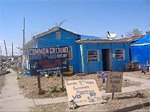
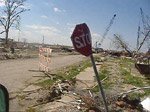
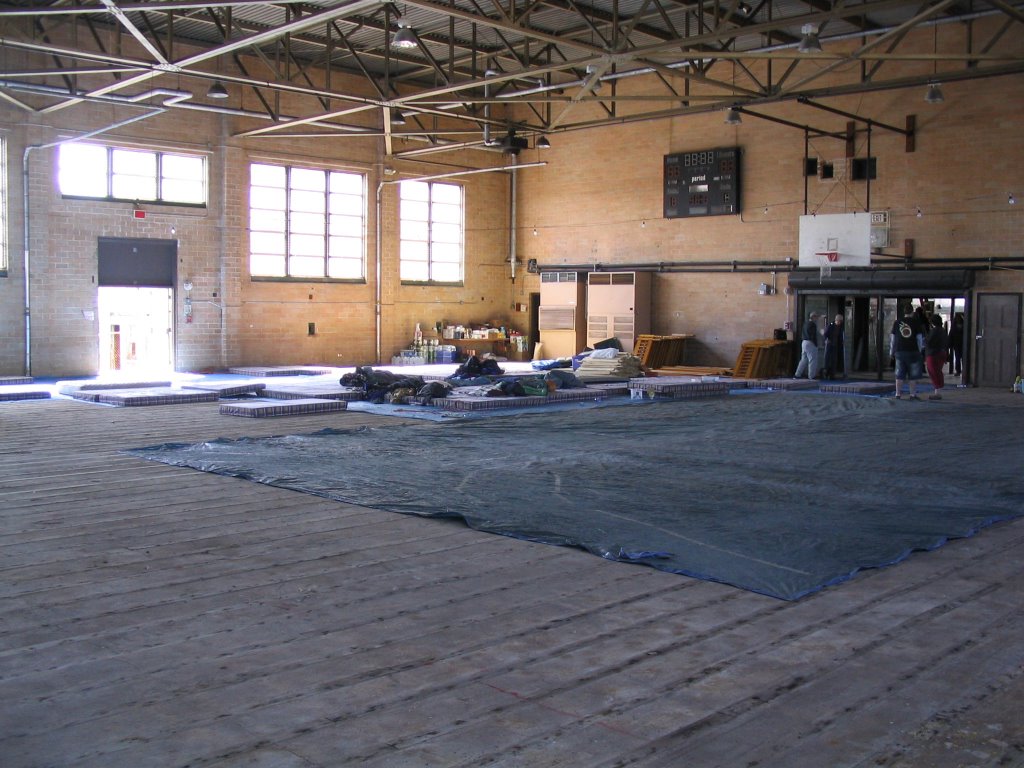
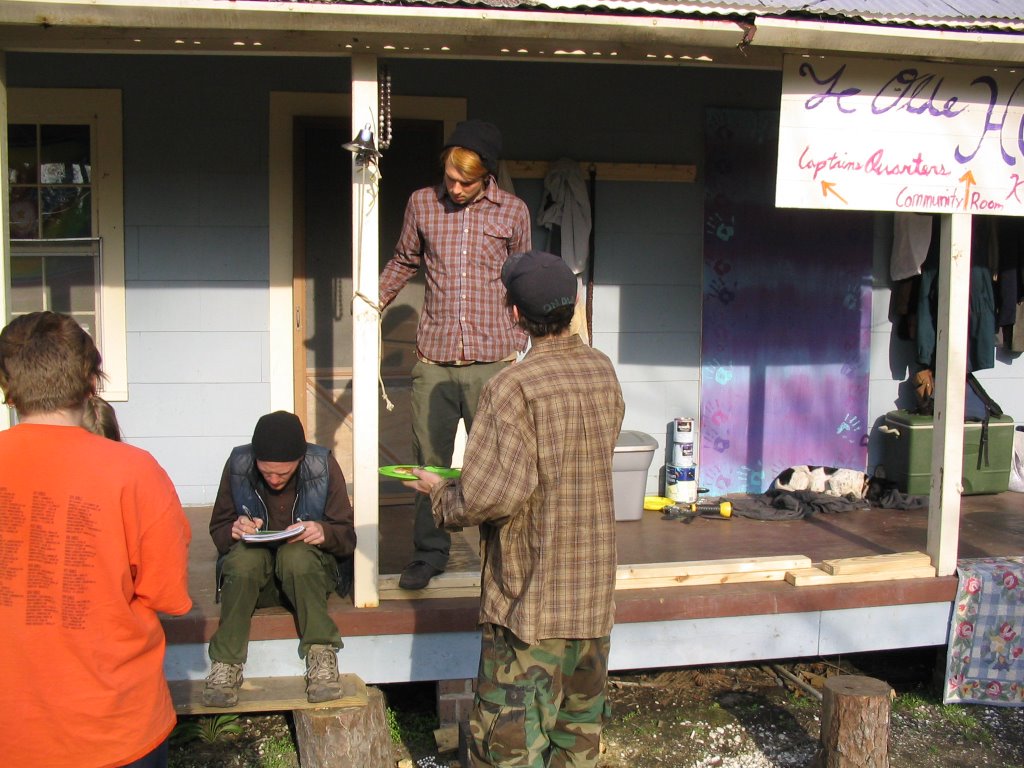
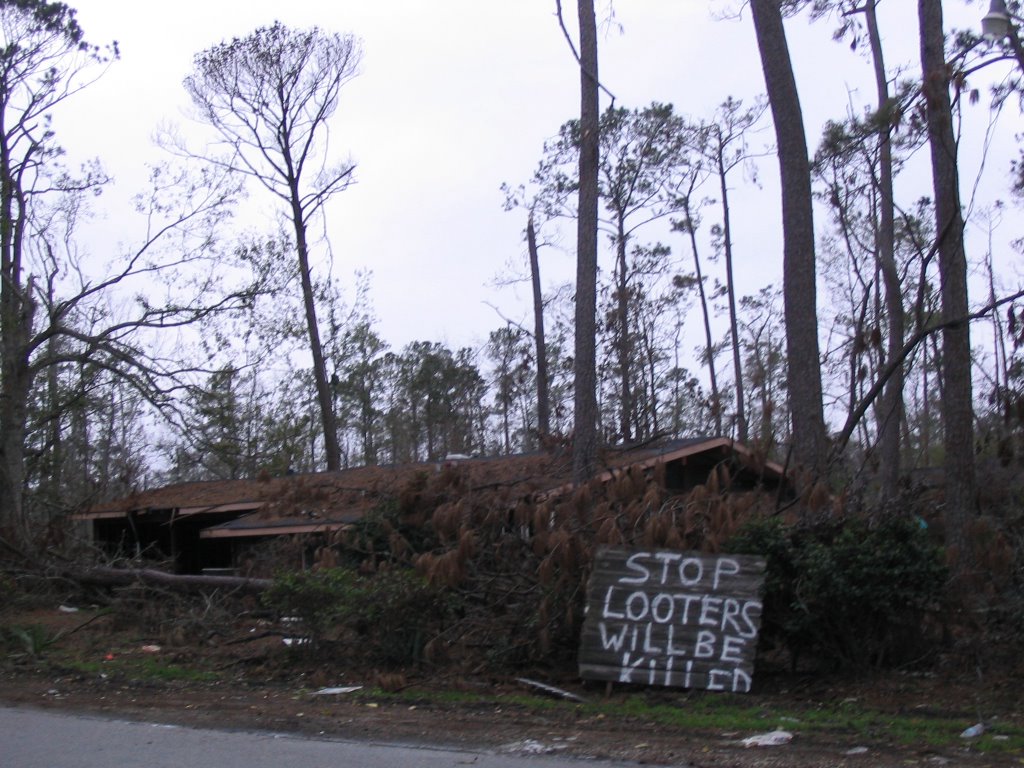
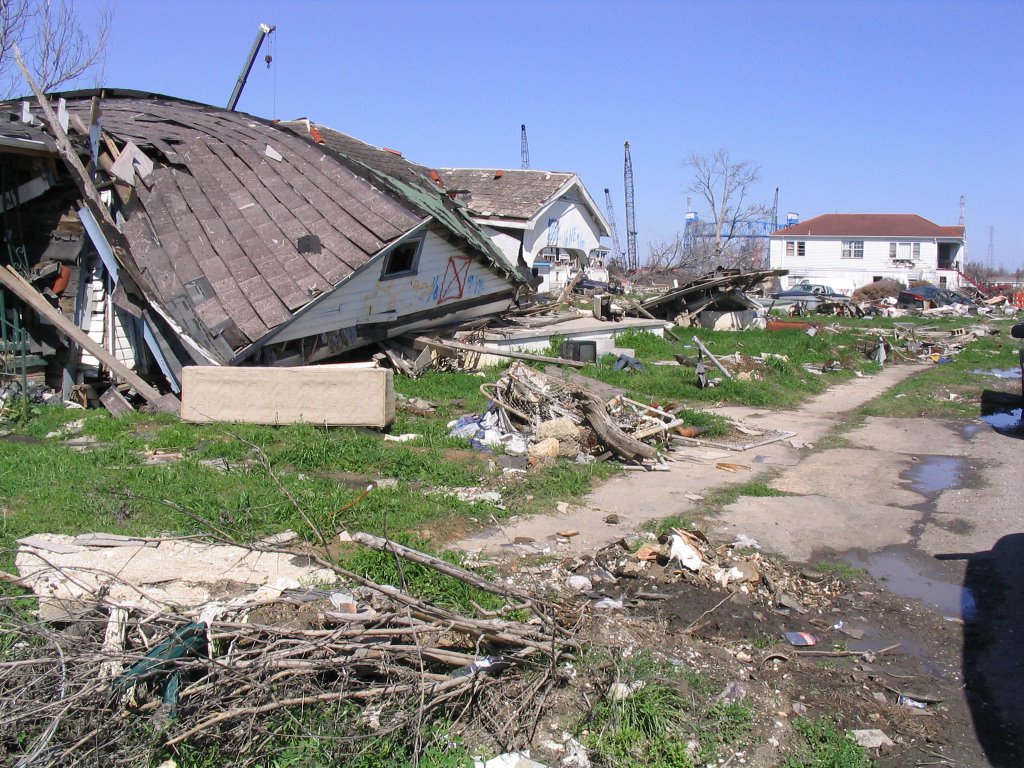
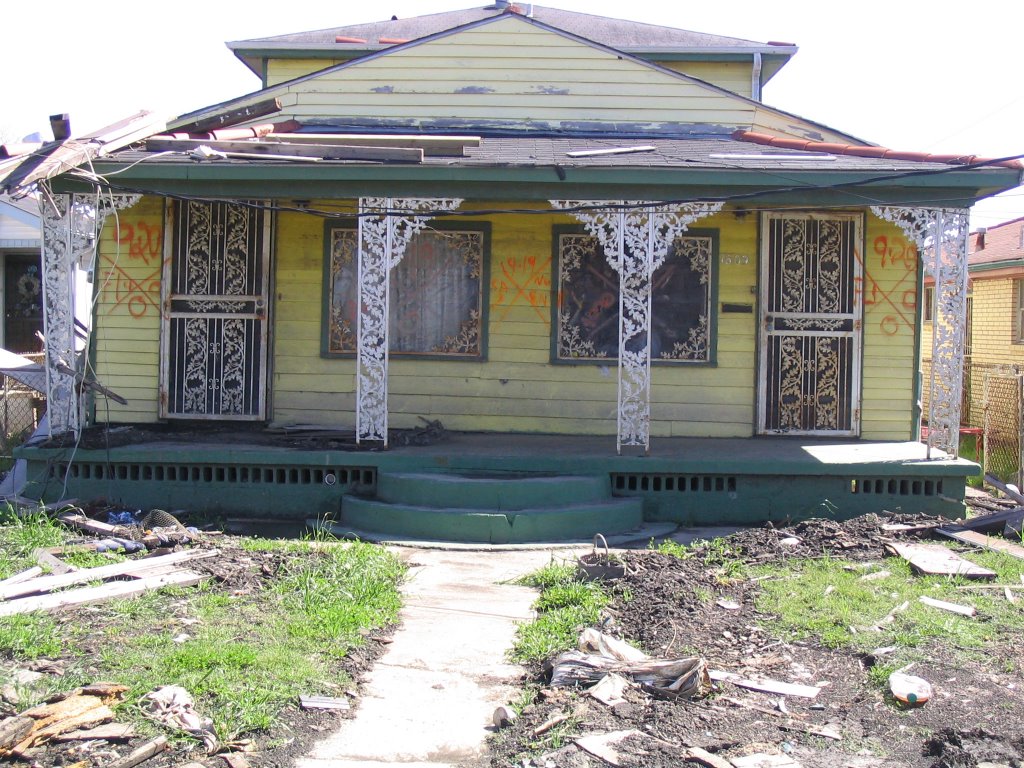
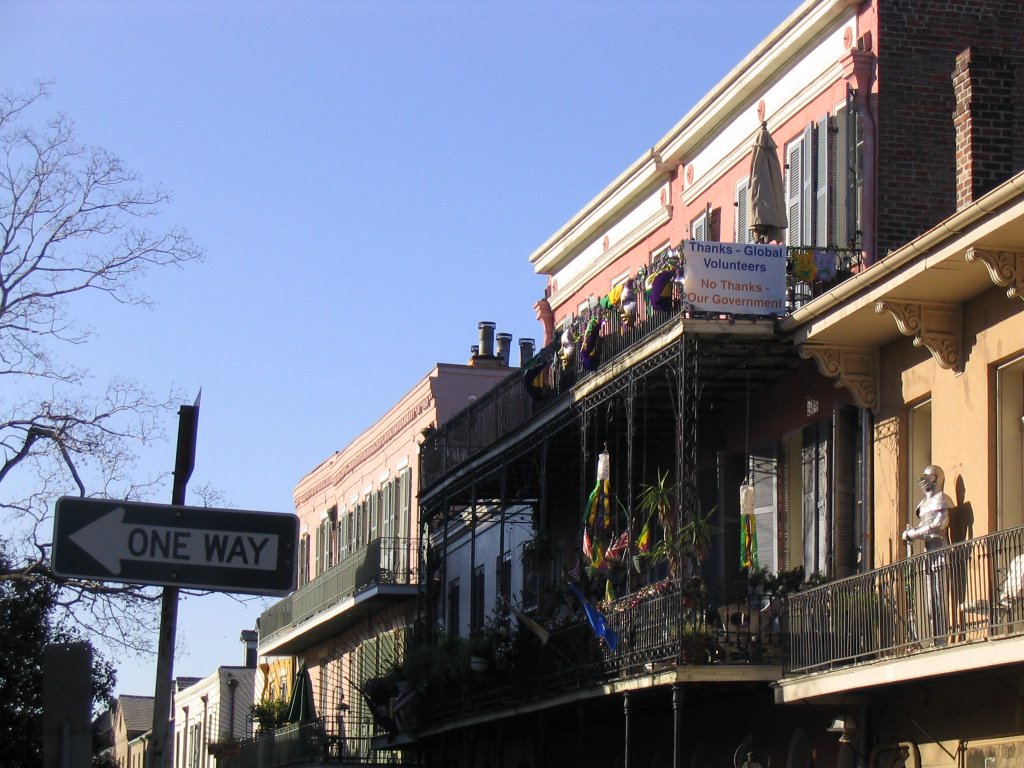
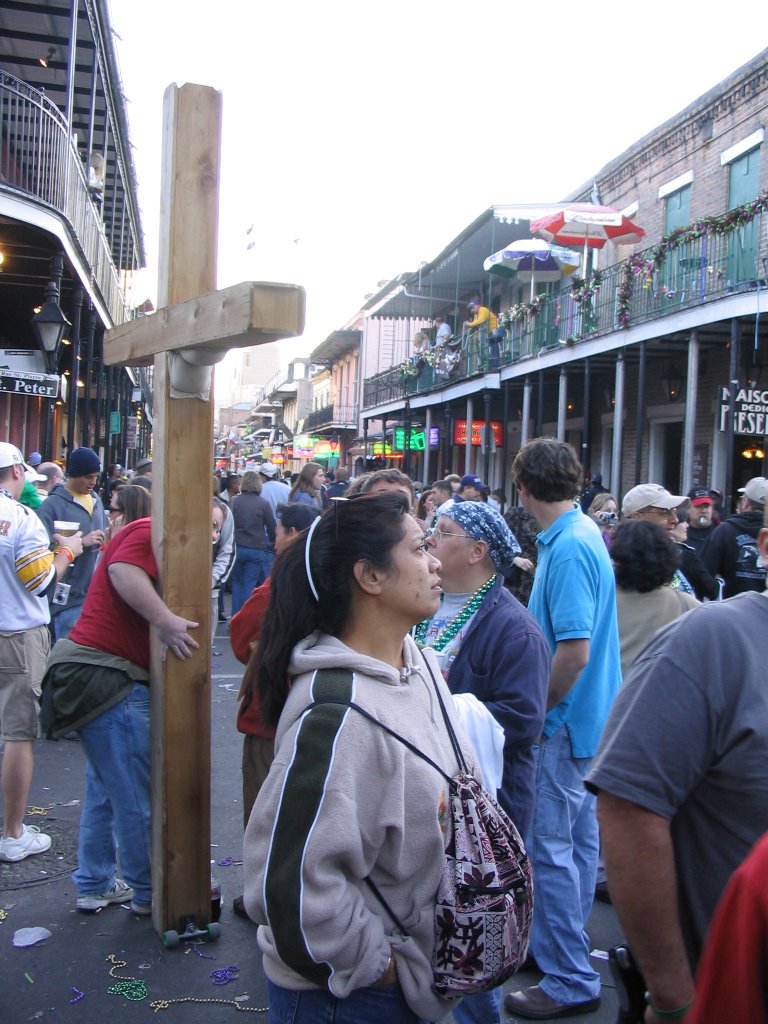
Some photos of my trip to New Orleans are below. Most of it is from the upper and lower 9th wards, though most of the work I did was actually in Slidell, a town about 30 to 40 minutes outside of New Orleans.

Some notes on the photos:

Common Ground is a grassroots volunteer organization that's been doing a variety of things from food distribution, to house gutting, to bioremediation. They have volunteer centers all over the city.

Meg's House is the bunk house at the Bayou Liberty Relief Camp and stands as a memorial to Megan Perry.

The markings on the doors were put there by inspection crews after the flooding. The top number is usually the date of inspection, the number or initials on the left signify the inspection team, the number on the right is the number of pets found, and the number at the bottom is the number of bodies found. "TFW" stands for "Toxic Flood Water" and "NE" stands for "No Evidence," which I believe is in reference to pets since it normally appears where the number of pets is located.

A couple of photos at the end are of the French Quarter.

(click on the photos for larger versions)


My experience in New Orleans was really amazing. I highly recommend taking some time to go and help out some. As a volunteer, housing and food are free. And I'd point out that I ate extremely well.

Hopefully, I'll get around to actually writing about this stuff a little more...

Thursday, February 23, 2006

activities participated in so far:
1. trash clean-up outside a daycare center in new orleans. this is the site of some planned bioremediation, which as i understand it is all about removing the toxins in the soil (of which there are many from a variety of sewage spills, oils spills, and general chemical mishaps resulting from the hurricane), and getting regular plant life to grow in it again. instead of using other man-made chemicals to do this, chemicals are generated through hippie flower power. various composting concoctions, mushrooms, etc. general the right chemicals and microorganisms to get rid of this stuff. there were some pretty bad chemicals that spilled during the hurricane and the flooding and a lot of the land has toxic chemicals that have seeped into its nooks and cranies. these are chemicals that apparently can cause neurological damage among other things, so it's a pretty important part of the effort to help people reestablish residences.

2. carl's house. carl is a retired u.s. marine whose house was ruined in the flooding. besides generally ridding the house of its mould infested objects, it's also been completely stripped down to its plywood floors and stud-walls. we've been using clorox to clean the mould that's left and scrubbing it down with brushes. respirators, biohazard suits, safety goggles, and gloves are a must. i arrived to help with the end of the bleaching and scrubbing. yesterday we began installing insulation. today we began installing drywall. in the meantime, carl had to go bail some relative out of jail in mississippi to the sum of some five grand. the fun never stops.

3. jen's house. i've not been yet, but it's more or less the same situation as carl's house. it needs to be gutted, cleaned of mould and then redone.

4. bayou liberty relief camp. the home base has been gradually accumulating upgrades, from a roof over the outhouse to new paint on walls and general cleaning.

that's about it for now. hopefully i'll get to post again soon about the group and life at the camp.
i barely made the plane to new orleans, as the early morning subway trains run far less frequently than i had expected. when i checked my bag in the jet blue lady told me to run to the gate. she did not, however, tell me which gate i should be running to. by the time i figured that out, the door to the walkway leading to the plane had been closed. lucky for me though the hatch to the plane was still actually open.

new orleans welcomed me with the message that my luggage did not make the flight. it ended up shipping on a flight later that afternoon and i managed to pick it up that evening. post parcel pick-up, the merry members of the hurricane autonomous workers collective, who i had been working with that day, and i headed to the bayou liberty relief camp in slidell, la. the bayou liberty relief camp functions as hawc's base of operations, storing equipment like goggles, rubber boots, biohazard suits, respirators, and all sorts of construction tools, as well as shelter, food, and items for recreation like a canoe, a bayou, and a guitar.

having been living in the urban jungle that is new york city, i had forgotten that mosquitos existed. that did not prevent them from trying to literally suck the lifeblood out of me. it is humid here and they are everywhere.

this does seem to really bother most of the members of hawc, from heading out to gut houses, scrub them clean of toxic waste and mold, and help reconstruct them. it's time for the morning meeting. i'll post again about our activities at a later date.

Monday, February 13, 2006

Dick Cheney... what a dick.

Cheney shot his millionaire hunting buddy. We're supposed to believe this was an accident. First of all, what the hell is Dick Cheney doing hunting? Shouldn't he be busy plotting the demise of civilization? Really though, for an administration that claims to have a lot of hard work to do all the time, they waste a lot of their efforts having fucking tea parties and and hugging their taxidermied animals. Hey, dipshits, how about instead of running around pretending like your fucking Roy Rogers, why don't you actually do some "hard work" and run the goddamn country like you're supposed to. Seriously. To quote Ivan Brunetti, "It's like a hamster trying to pilot a spaceship."

Also, as an amusing sidenote, the hunting buddy he shot was 78 years old. At that age it's probably best that he took one for the team. What the hell is a 78 year old man doing running around in the wilderness with a shotgun? Really, this kind of activity should be regulated. I mean, for god's sake, they have rules of fucking participation for fucking bumper cars. Jesus fuck.

Wednesday, February 01, 2006

It's apparently all the rage...

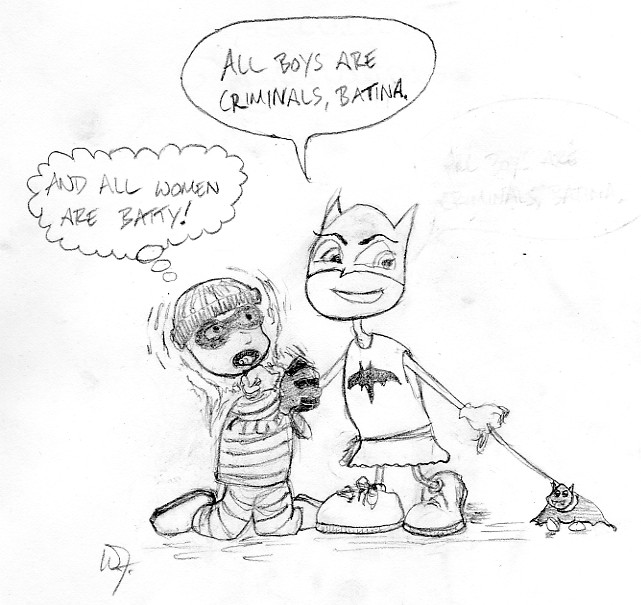
...and no, i'm not talking about the artic monkeys. rather, there's a virus going around, and the only cure is batgirl...


it's a batgirl meme! for nearly 1000 other, better renditions (many by actual professional artists) of everyone's favorite bat-stamped heroine, go here.

thank you, lunch hour.

Monday, January 23, 2006

help the hairy hare hide the hairy whore.

well, part deux of my bit about comics is taking longer than expected. so in the meantime we'll be back to our regularly scheduled programming by my usual jerkface, hippy, twinkletoes self.

see images from my morning walks during the nyc transit strike:


Tuesday, January 10, 2006

The Death of Comic Books

For a person who often is associated with comic books, I've barely touched on the subject here in my itty-bitty nook of the interweb. A lot of that has to do with the fact that I stopped collecting them. When I write "collecting" I mean it in the sense that I don't buy single issues on a regular basis, letting my obsessive-compulsive side get the better of my wallet and what little unused space my etcetera-saturated, humble abode has. It's been a couple of years since I stopped going to conventions, looking for those elusive back issues to series that I yearned to have in order to fill the missing holes that plagued my life---Aztek: The Ultimate Man #9, for instance---even though I'd long ago stopped reading them. Why I stopped collecting isn't a story of a triumph of the human will over its own body's miserable, debilitating habits; while I was quite the fanboy, I never had it that badly. Between the ages of 11 and 20 I probably amassed two thousand comics at most---and that's a generous guestimate---which pales in comparison to the eight to ten thousand comics a couple people I know now have stored in long cardboard boxes. Rather, this has more to do with my own maturing coupled with the evolution of an industry that has, since the mid-1950s to the mid-1990s, been more-or-less stuck in perpetual pre-adolescence.

A Very, Very Brief History of the American Comics Industry Since 1954, or Why Comics are the Way they are (More-or-Less, as I Know it)

A number of you may already know about the Seduction of the Innocent scandal---Dr. Fredric Wertheim's well intended, but misdirected book associating juvenile delinquency with comic books. In the aftermath of the book's publication were some instances of parents burning their kids' comics, congressional hearings, and eventually the industry's own establishment of the Comics Code Authority. The Comics Code, which had a similar purpose to the MPAA's rating system, was meant to be a symbol of which comics were appropriate for kids, and which comics were lurid drivel. (Some examples of rules the CCA laid down are "In every instance good shall triumph over evil and the criminal punished for his misdeeds," " No comic magazine shall use the word 'horror' or 'terror' in its title," "All characters shall be depicted in dress reasonably acceptable to society." Obviously some rules were adhered to more strictly than others.)

Amid all the hoopla surrounding the Wertheim's book, the fact that a fairly large part of the comics reading audience were older---former G.I.'s from World War II, for example---was simply forgotten about. Sales that were already slumping due to the bad publicity, but when the Code virtually dictated that the content of comics be geared toward children, the industry lost another significant portion of its readership.

Once the Code was instituted, pretty much every comics publisher finagled their stable of comics to adhere to the new rules. Not having the CCA stamp of approval was the kiss of death for a comic book. Your average corner store wouldn't carry comics that were missing the CCA logo on their covers for fear of being accused of selling obscene material to children by overzealous parents. And at a time when newsstand and drugstore sales were the driving retail force of the industry---comic book specialty stores weren't conceived of at this point---that meant if you didn't have a CCA stamp adorning your books, you couldn't sell any comics.

One conspiracy theory has it that the rules of the CCA were drawn up specifically to put EC Comics out of business. EC Comics was one of the most popular and successful comics publishers of the time, churning out mainly crime and horror comics, which featured a number of things explicitly banned by the CCA. In the end EC's only publication to survive was MAD Magazine.

The death of EC Comics left the racks open for superhero and romance comics to proliferate. Eventually most of the romance comics fell by the wayside and superheroes became pretty much the only game in town (resulting in comics readership being almost exclusively male). And this was the way things stayed for about 35 years, with a couple of exceptions. First, there was a fairly successful underground comics movement in the 1960s---its most famous patron being R. Crumb---which is known mainly for acting as an outlet for subversive political and sexual ideas, though it appears to have had relatively minimal impact on popular culture. Second, in the mid-to-late-1980s there was a shift in the market and some comics began to skew toward some darker themes. DC comics began publishing dark fantasy and horror comics again with the likes of Swamp Thing as written by Alan Moore and Sandman by Neil Gaiman. Meanwhile Marvel helped establish the anti-hero as the most popular type of protagonist in superhero comics---the Punisher and Wolverine being the two most recognizable characters in this mode.

It was also around this time that the distribution system changed, comics became increasingly scarce at newsstands and corner stores, while at the same time comics specialty stores began setting up shop. This new direct market was partially the result of kids who'd grown up reading comics and never stopped. As adults they were able to hold onto their childhood hobby by turning it into a profession, turning into collector--purveyors. At the same time the comics that a lot of people collected as kids in the 1960s had been thrown out by parents. Propelled perhaps at first by nostalgia or an obsession to fill out gaps in a collection, but later as much by these motivations as pure capitalism, the comics collectors began searching for those now rare, old comics from yesteryear, and thus the back-issue market was born. Rare back-issues became valuable commodities due to their relatively high demand.

Through the luck of a well made Batman movie and a little publicity, the John Q. Public now knew that (a) comics still existed and (b) some of them were worth more than a Benz. The result was a huge influx of new comics buyers. While a number of them were in it for the fun of reading and collecting, there was also a strong contingent of speculators---people who bought comics based on their promise for future value with the goal of reselling them at huge profits. The problem here was that speculators were buying multiple copies of comics that they thought would be worth a pile of money later on, while at the same time the number of collectors skyrocketed. Over the next couple of years print runs went through the roof, to the point where copies of supposedly landmark comics like Superman #75 (the issue where Superman dies) and X-Men #1 sold multiple millions of copies. Of course, this threw the supply and demand equation all out of whack. More comics existed in the market than potential buyers. All of those comics people bought, with the expectation that they'd one day be able to sell them and retire, were actually worth bupkiss because everyone already had multiple copies of them.

While all this was going on, what did the major comics publishers do? They had a gift-horse dropped in their lap---rapidly increasing audience and profits, which seemed to be based on the fact that comics were worth money. They flooded the market with "collectors items" and replications of proven formulas: issues with limited edition alternate covers; new spin-offs of popular series that allowed for those big sales of coveted #1 issues slavered over by collectors; team-ups; big slug-fests; and copycat artists who swiped the styles of the most popular artists of the time. In the end, most of what was produced were poorly written and poorly drawn, schlocky power fantasies. Good storytelling was out the door in favor of gimmicks in order to make a quick buck. Once the collectors got wise to what was going on (and it took a couple of years, 'cause lets face it, fanboys aren't necessarily the swiftest cats in the barrel), they stopped buying. After all, who would want a bad piece of art that wasn't worth the paper it was printed on? Publishers went from selling hundreds of thousands of copies per issue of their most popular titles, to tens of thousands. The market went bust. Big time. Marvel Comics, the biggest comics publisher in the nation, filed for Chapter 11 bankruptcy by the mid-1990s, and comic stores all over the nation started closing shop.

At this point, the companies really had nothing to lose. A number of industry insiders were predicting the death of comics in the next five to ten years. An editorial shake-up at Marvel coincided with its financial reorganization. Over-hyped team-ups, big crossover events, and embossed covers were out. Fresh faces who'd cut their teeth in a re-surging indie comics scene, or in other media, were in. Emphasis was put on good, old fashioned storytelling rather than market trends. Companies' flagship comics that had been mired in stories requiring knowledge of years of continuity had been replaced with fresh spins on characters and clever new takes on old ideas. "Relaunch" was the word of the day.

The success of the first Matrix and X-Men movies put comics back in the spotlight of the mainstream press. Coming to terms with an audience that was closer to an 18-to-35 year-old demographic than the 8-to-14 year-old age group that comics had a reputation for serving, made publishers realize that making comics aimed at 8-to-14 year-olds probably wasn't the best way to move units. Since the mid-1980s the comics industry began catering increasingly to this older set of readers, but it wasn't until the late 1990s and early 2000s that major publisher's mainstream titles began to, in terms of tone and subject matter, regularly tackle more complex political, emotional, psychological, and sexual issues. (Here are some examples. Marvel Comics began its Marvel Knights imprint, which published Daredevil stories tackling issues like death and child abuse; Black Panther plot lines had him hunting down the killer of the poster child for a humanitarian aid organization while at the same time negotiating his way through a coup de tat of his throne; a post-9/11 Captain America re-evaluates his purpose as an American symbol and America's role in an increasingly tension-filled global society. Meanwhile, the other big gun, DC Comics, publishes the likes of Kingdom Come, a critique of the popular anti-hero figure within mainstream comics, with near photo-realistic watercolor paintings as its interior art; its Wildstorm imprint launches, Ex Machina, a series about a fictional mayor of New York---and former superhero---and his political doings; Vertigo (DC's imprint geared specifically to mature readers) finally escapes from the shadow of its most popular titles, Sandman and Preacher, to establish itself with a diverse stable of books including Y: The Last Man (a dramedy/adventure dealing mainly with the politics of sex and gender) and Lucifer (a series that delves into postmodern definitions of good and evil); and Alan Moore's ABC imprint, which explores a variety of pulp genre's, but manages to analyze them all in Promethea, a philosophical discussion of the origins of storytelling and its purpose, wrapped in the guise of a sci-fi fantasy. Meanwhile, smaller publishers are getting in on the adult action too. Dark Horse continued to publish the likes of Frank Miller's Sin City and reprint landmark manga like Akira and Lone Wolf and Cub. Pantheon, Top Shelf, Drawn and Quarterly, and Fantagraphics all have been working to publish more literary works that have garnered incredible critical praise and true mainstream press attention, such as Jimmy Corrigan, Persepolis, Box Office Poison, Blankets, Berlin, and Safe Area Gorazde. The list goes on. I've yet to even mention Image Comics, AIT/Planet Lar, or SLG.)

Bookstores wised up about the same time as comics publishers and began setting up small sections in stores dedicated to graphic novels and collected editions of serials. For the first time in over a decade, comic books were finally available in relatively large quantities outside of comics specialty shops. Needless to say, this extra exposure (along with the films and write-ups in publications like the New York Times Book Review) helped draw in new readers, and a new type of audience---the casual reader. The advent of the collected editions and one-off original graphic novels, meant that people could pick up a book, go home and read it, and not be left hanging for the continuation of the story until the next issue came out a month later. They got the whole story in one shot and never had to get in the habit of making monthly or weekly trips to the comics shop to finish a story. It seems like a small thing, increasing the page count of a comic book, but moving from novelties to novels has slowly begun a massive shift in the comics industry.

Monday, January 02, 2006

AGSFB

Things one does not want to arrive home to find include: (1) cockroaches skittering about the sink (2) a leaky toilet (3) a leprechaun trying to steal your cereal. Lucky for me only two out of these three things were waiting for me upon my return to my beautiful (pre-war?) apartment. A bucket took care of the leak temporarily. Upon further inspection though, it seems the bolts fixing the tank to the seat had completely rusted through to the point of disintegrating when I touched them. The water was leaking through the holes for the bolts at the bottom of the tank. I managed to pick up some replacement bolts and rubber washers from Home Depot, but we've still got a bit of a drip. Cockroaches are a tougher nut to crack--or stomp on--their exoskeletons provide resistance to a number of smooshing techniques. And they're faster than lint.

There was some actual fun stuff going on this weekend: pizza with Mike Mcghee and his brother at Lombardi's, dinner with Brendan & Co., a party at Corinne and Wilburn's, watching the 'Skins make the playoffs for the first time in six years, and a well behaved Catsby.

Going back in time, my vacation at home felt a lot like October break. I spent two or three days hanging with family, a couple of days bumming around with some friends, saw four movies (King Kong, Good Night and Good Luck, Munich, and Say Anything), read most of Safe Area Gorazde. Channukah was pretty low key. The whole gift-giving culture we've established seemed, well, not entirely hollow, but really it feels like people are just going through the motions, myself included (perhaps with the exception of a mix cd I made for my sister repleat with cover design). The gifts for the most part are given for the sake of the gesture. But it also seems like a giant regrettable waste, especially in light of Megan's passing. I mean that in the sense that it all seems somewhat insignificant in the wake of her loss, but also that the people who really actually need all this stuff are not us. The people who need the clothes and money I received are the people that Megan was working so hard to help. Of course the sentiments are nice, but that doesn't necessarily mean they're good. It seems misguided. Did you really want that turtleneck you cousin gave you? Imagine who does. Imagine who actually needs it. I would guess that what most of the people I know really want or need is too often immaterial, and rather is emotional, or psychological, or experiential, and all this stuff we're exchanging is just that--stuff (how cliché). It's white noise that's distracting us from perhaps what's really important to not just ourselves but all those around us. My brother and Suzanne at least have part of it right. They've been making donations for a while now instead of giving people stuff they don't want or need. I sound like a total commie-pinko. Really though, while I don't plan on selling all my possessions, donating the money, and going off to live in a tent in some vacant lot, I am trying to re-prioritize my values.

Going even further back in time, on the bus ride down to Maryland, besides being regaled with details of some bronx-born construction worker's love-life that no one wanted to hear, I rediscovered the joy of the All Girl Summer Fun Band.